Fender Serial Number Decoder
(updated version 04.2026)
To find information about your Fender guitar, enter the serial number and click the Check button. You’ll see the country of manufacture, production date, and the factory where the guitar was made.
If a serial number falls into overlapping ranges, the decoder shows all possible matches for the origin and production date of your guitar or bass.
Quick Navigation
Where Is the Fender Serial Number Located?
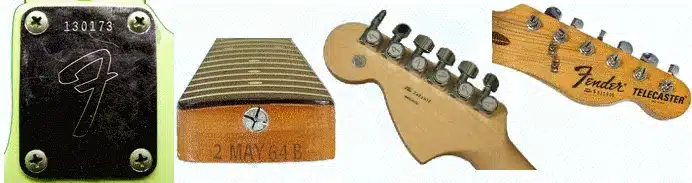
You can find the Fender serial number at the top of the neck plate, on the front or back of the headstock, on the vibrato cover plate (for Stratocaster), or at the end of the neck heel.
Fender Serial Number 1950-1963
In the early 1950s, the serial number of the Fender Stratocaster was imprinted on the back of the tremolo cover plate. For some Fender Telecaster guitars, the serial numbers were placed on the bridge, nestled between the pickup and the saddles.
Fender’s manufacturing process in the early 1950s sometimes resulted in inconsistent serial numbers. Duplicate and reused serial numbers are also common.
For guitars made before 1955, you cannot determine the exact production date from the serial number alone. Initially, the Telecaster and Stratocaster models appeared to use different numbering systems, with the ’52 Telecaster possibly having a higher serial number than the ’53 model.
The only way to find out the production date is to remove the neck from the guitar’s body. If the year isn’t clear, it can also be written on the body under the pickguard or within the pickup cavity.
Serial numbers on Fenders made after 1955 follow a more consistent and logical sequence.
The database below shows the serial numbers as they were used from 1950 to 1963.
Fender US Serial Number Chart 1950-1963
| Serial No | Production Year |
|---|---|
| Until 6000 | 1950 – 1954 |
| Until 10000 | 1954 – 1956 |
| 10000 | 1955 – 1956 |
| 10000 – 20000 | 1957 |
| 20000 – 30000 | 1958 |
| 30000 – 40000 | 1959 |
| 40000 – 50000 | 1960 |
| 50000 – 70000 | 1961 |
| 60000 – 90000 | 1962 |
| 80000 – 90000 | 1963 |
| 90000 – L10000 | 1963 |
Telecaster Serial Number 1950-1954
For the Telecaster, Esquire, and Broadcaster models, serial numbers were located on the bridge plate until early 1954. Fender then switched to serial numbering on the heel plate for all models that year.
Esquire, Broadcaster, Telecaster Serial Number Chart (1950-1954)
| Serial Number | Production Year |
|---|---|
| 0001 – 0999 | 1950 – 1952 |
| 1000 – 5300 | 1952 – 1954 |
Precision Bass Serial Number 1951-1955
The Precision Bass experienced some overlapping of serial numbers and dates. Until 1955, the serial number was stamped on the bridge plate. Even though Fender switched to placing serial numbers on the headstock for all models in 1954, they continued to stamp them on the bridge plate for some Precisions.
P-bass serial number Chart (1951-1955)
| Serial No | Production Year |
|---|---|
| 100 – 400 | 1951 – 1952 |
| 0001 – 0999 | 1952 – 1954 |
| 1000 – 2000 | 1953 – 1955 |
Fender Serial Number 1963-1976
In January 1965, Fender was bought by CBS Corporation. This acquisition didn’t directly affect the serial numbers. CBS kept making guitars using the existing parts and serial numbering system.
The serial number can usually narrow down the production period.
- The letter “L” followed by the 6-digit serial number on the Fender neck plate indicates an instrument from the early 60s.
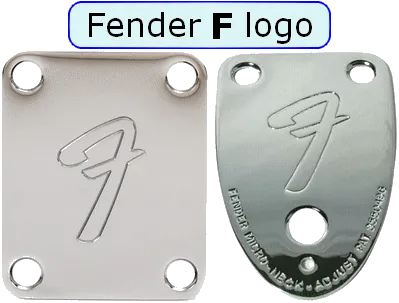
- A large Fender “F” on the neck plate usually indicates a guitar made during the CBS era.
The following database outlines Fender serial numbers from 1963 to 1976. The serial numbers are in chronological order, but due to Fender’s numbering practices, many serial numbers and years overlap.
Fender US Serial Number Chart 1963-1976
| Serial Number | Production Year |
|---|---|
| L00001 – L19999 (Neck Plate) | 1963 |
| L20000 – L58999 (NP) | 1964 |
| L59000 – L99999 (NP) | 1965 |
| 100000 – 109999 | 1965 |
| 110000 – 199999 | 1966 |
| 200000 – 209999 | 1967 |
| 210000 – 249999 | 1968 |
| 250000 – 279999 | 1969 |
| 280000 – 299999 | 1970 |
| 300000 – 339999 | 1971 |
| 340000 – 369999 | 1972 |
| 370000 – 499999 | 1973 |
| 500000 – 519999 | 1973 – 1974 |
| 520000 – 579999 | 1974 |
| 580000 – 689999 | 1975 |
| 690000 – 750000 | 1976 |
Fender Neck Date (Before 1976)
For guitars made before 1976, it’s recommended to check the production date or serial number on the neck’s heel. Typically, a production date is stamped or written at the end of the heel. To read this, you’ll need to remove the neck from the body.
Up until about April 1962, the dates on the neck heel were handwritten, after which Fender switched to stamped dates. Both the handwritten and the stamped dates were usually coded.
This code, appearing before the date, is a number from 1 to 28, indicating the model for which the neck was manufactured. Contrary to some beliefs, this number does NOT represent the day of the month.

Fender Patent Numbers (1960-1976)
Between 1960 and 1977, various patent numbers were added to Fender models. They were stamped in the headstock under the Fender logo.

For example:
PAT, 2,573,254 2,968,204 3,143,028 2,976,755 DES 187304
2,573,254 for pickup and bridge combination.
2,968,204 for the single coil pickup patent awarded in 1961 under others for Fender Jaguar, Stratocaster, and Duosonic.
3,143,028 the patent granted in August 1964 for Fender’s adjustable neck construction.
2,976,755 for the split coil pickup design (used since 1957 for the Precision Bass).
The DES is the serial number.
Fender Serial Number 1976-1981
The following database shows the most common Fender serials from 1976 to 1981. Note the addition of a letter prefix to the serial number. The “S” prefix indicates the 1970s, a method CBS used in an attempt to clearly mark serial numbers by production year. However, there were still many overlaps, making precise dating based on the serial number sometimes unclear.
Fender US Serial Number Chart 1976-1981
| Serial Number | Production Year |
|---|---|
| 76 + 5 digits S6 + 5 digits | 1976 |
| S7 + 5 digits S8 + 5 digits | 1977 |
| S7 + 5 digits S8 + 5 digits S9 + 5 digits | 1978 |
| S9 + 5 digits E0 + 5 digits | 1979 |
| S9 + 5 digits E0 + 5 digits E1 + 5 digits | 1980 |
| S9 + 5 digits E0 + 5 digits E1 + 5 digits | 1981 |
Fender Serial Number 1982-1989
In 1982, the Fender American Vintage Series was introduced, using “V” as the serial number prefix. For guitars from the American Vintage Series, it’s best to check the neck’s date for a specific year.
The “E” prefix, representing the 1980s, was first introduced in 1979.
Fender USA Serial Number Chart 1982-1984
| Serial Number | Production Year |
|---|---|
| E1 + 5 digits E2 + 5 d. E3 + 5 d. V + 4, 5, or 6 d. (American Vintage Series excluded ’52 Telecaster) | 1982 |
| E1 + 5 d. E2 + 5 d. E3 + 5 d. V + 4, 5, or 6 d. (US Vintage excluded ’52 Telecaster) | 1983 |
| E3 + 5 d. E4 + 5 d. V + 4, 5, or 6 d. (US Vintage excl. ’52 Telecaster) | 1984 |
In March 1985, CBS Corporation sold Fender to a group of private investors led by William Schultz. After the sale, the company was renamed Fender Musical Instruments Corporation. Despite the change in ownership, the serial numbering system remained the same.
Fender US Serial Number Chart 1985-1989
| Serial Number | Production Year |
|---|---|
| E3 + 5 digits E4 + 5 d. V + 4, 5, or 6 d. (American Vintage Series*) | 1985 |
| V + 4, 5, or 6 d. (US Vintage*) | 1986 |
| E4 + 5 d. V + 4, 5, or 6 d. (US Vintage*) | 1987 |
| E4 + 5 d. E8 + 5 d. V + 4, 5, or 6 d. (US Vintage*) | 1988 |
| E8 + 5 d. E9 + 5 d. V + 5 or 6 d. (US Vintage*) | 1989 |
To accurately identify the production date of a Fender Stratocaster with a “V” serial number from the American Vintage series, you need to unscrew the neck from the body. The production date is stamped or written on the end of the heel.
Fender Serial Number 1990-1999
In 1990, Fender introduced the “N” prefix for serial numbers to denote the 90s. The serial number stickers were produced well in advance, leading to an issue where N9 stickers, intended for use in 1999, were mistakenly applied to some instruments made in 1990. Therefore, it’s possible to find guitars from 1990 with an N9 serial number.
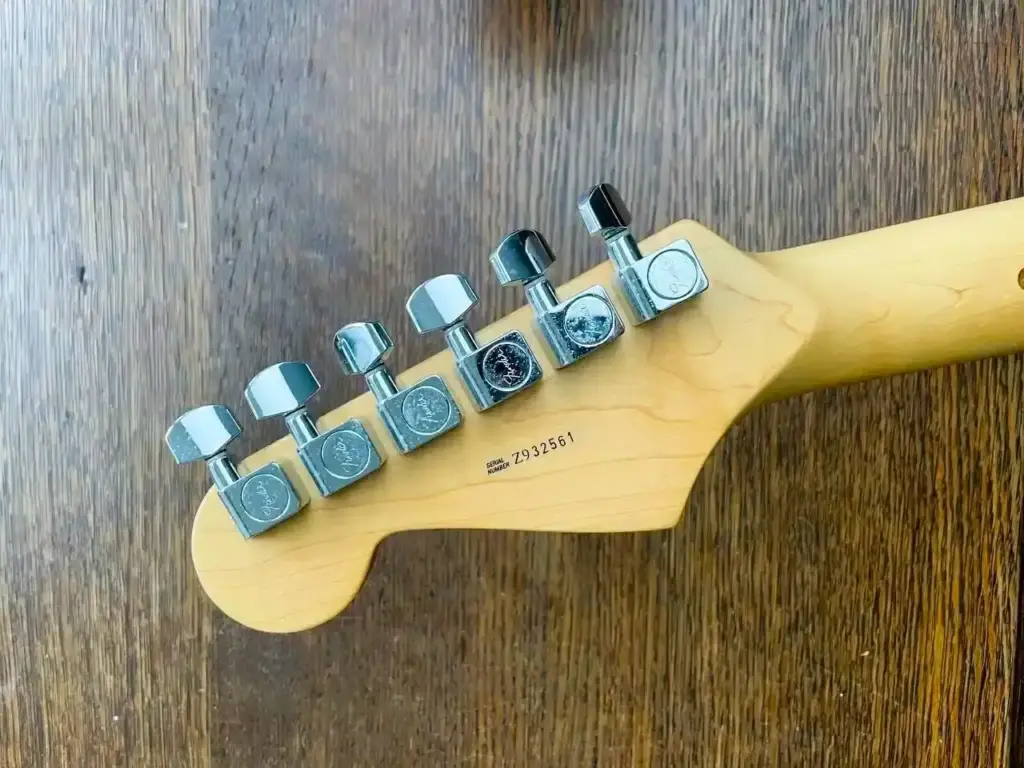
For instruments made in 1990, the serial number is located on the front of the headstock. In 1996, Fender shifted the placement of serial numbers to the back of the headstock.
Fender US Serial Number Chart 1990-1999
| SERIAL NUMBER | PRODUCTION YEAR |
|---|---|
| N9 + 5 numerals N0 + 5 nums V + 5 or 6 nums (American Vintage Series*) | 1990 |
| N1 + 5 or 6 nums V + 5 or 6 nums (American Vintage*) | 1991 |
| N1 + 5 or 6 nums N2 + 5 or 6 nums V + 5 or 6 nums (US Vintage*) | 1992 |
| N3 + 5 or 6 nums V + 5 or 6 nums (US Vintage*) | 1993 |
| V + 5 or 6 nums (US Vintage*) | 1994 |
| N4 + 5 or 6 nums N5 + 5 or 6 nums V + 5 or 6 nums (US Vintage*) | 1995 |
| N6 + 5 or 6 nums V + 5 or 6 nums (American Vintage*) | 1996 |
| N6 + 6 or 6 nums N7 + 5 or 6 nums V + 5 or 6 nums (American Vintage*) | 1997 |
| N8 + 5 or 6 nums V + 5 or 6 nums (American Vintage) | 1998 |
| N9 + 5 or 6 nums V + 5 or 6 nums (US Vintage*) | 1999 |
Fender Serial Number 2000-2009
Starting in 2000, the “Z” symbol was used to represent the 2000s. The Z0 prefix indicates the year 2000, Z1 – 2001, and so on.
The American Deluxe Series follows the same pattern but adds the symbol “D” before “Z”, such as DZ1 for 2001, DZ2 for 2002, etc. However, there are still instances of overlap between serial numbers and production years.
Fender US Serial Number Chart 2000-2010
| SERIAL NUMBER | PRODUCTION YEAR |
|---|---|
| N9 + 5 or 6 symbols Z0 + 5 or 6 symbols DZ0 + 5 or 6 symbols (American Deluxe Series) V + 5 or 6 symbols (US Vintage*) | 2000 |
| Z0 + 5 or 6 symbols Z1 + 5 or 6 symbols DZ1 + 5 or 6 symbols (American Deluxe) V + 5 or 6 symbols (American Vintage*) | 2001 |
| Z1 + 5 or 6 symbols Z2 + 5 or 6 symbols DZ2 + 5 or 6 symbols (US Deluxe) V + 5 or 6 symbols (American Vintage*) | 2002 |
| Z2 + 5 or 6 symbols Z3 + 5 or 6 symbols DZ3 + 5 or 6 symbols (American Deluxe) V + 5 or 6 symbols (US Vintage*) | 2003 |
| Z3 + 5 or 6 symbols Z4 + 5 or 6 symbols DZ4 + 5 or 6 symbols (US Deluxe) V + 5 or 6 symbols (American Vintage*) XN4 + 4 symbols | 2004 |
| Z4 + 5 or 6 symbols Z5 + 5 or 6 symbols DZ5 + 5 or 6 symbols (American Deluxe) V + 5 or 6 symbols (American Vintage*) XN5 + 4 symbols | 2005 |
| Z5+ 5 or 6 symbols Z6 + 5 or 6 symbols DZ6 + 5 or 6 symbols (American Deluxe) V + 5 or 6 symbols (American Vintage*) XN6 + 4 symbols | 2006 |
| Z6 + 5 or 6 symbols Z7 + 5 or 6 symbols DZ7 + 5 or 6 symbols (American Deluxe) V + 5 or 6 symbols (American Vintage*) XN7 + 4 symbols US + 8 symbols | 2007 |
| Z7 + 5 or 6 symbols Z8 + 5 or 6 symbols DZ8 + 5 or 6 symbols (American Deluxe) V + 5 or 6 symbols (American Vintage*) XN8 + 4 symbols US + 8 symbols | 2008 |
| Z8 + 5 or 6 symbols Z9 + 5 or 6 symbols DZ9 + 5 or 6 symbols (American Deluxe) V + 5 or 6 symbols (American Vintage*) XN9 + 4 symbols US + 8 symbols | 2009 |
Modern Fender Serial Number Since 2010
At the end of 2009, a new 9-digit Fender serial number format was introduced. This format is prefixed with the number “10” (which stands for the second decade of 2000) followed by 7 numerals.
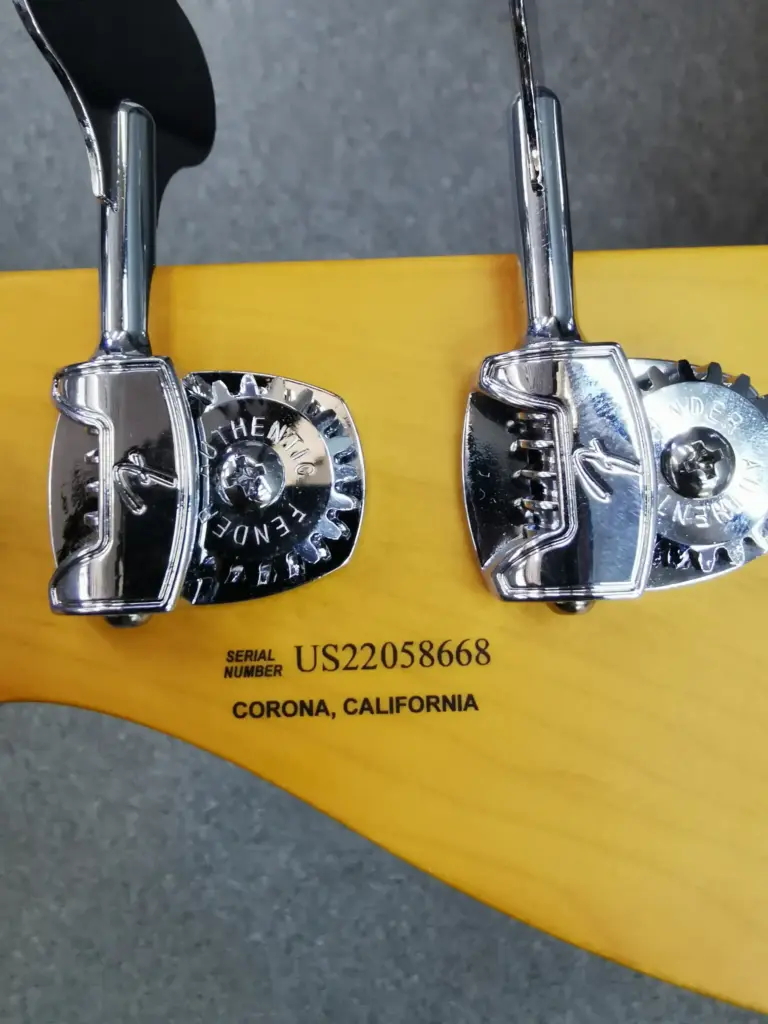
In March 2010, this format was replaced by a new 8-digit format. The two-letter prefix indicates the production location. The first 2 digits after the letters represent the production year. The remaining digits are random and do not provide additional information.
For example: US22058668. The guitar was manufactured in the USA, in 2022.
Fender US Serial Number Chart Since 2010
| SERIAL NUMBER | PRODUCTION YEAR |
|---|---|
| 10 + 7 symbols (Vintage Series except for ’52 Tele, which uses a five-digit number) | End 2009 – March 2010 |
| US + 8 symbols (Vintage Series except for ’52 Tele, which uses a five-digit number) The first two symbols of the number identify the year of manufacture. | Since March 2010 |
Japanese Fender Serial Number
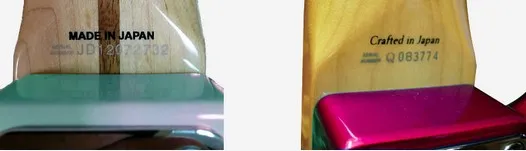
Fender guitars produced in Japan have their serial numbers located on the back of the neck, near where they attach to the body. For some reissue models, the serial number may be found on the headstock or heel plate.
Fender used the “Made in Japan” label with these serial numbers until 1997.
In March 1982, Fender expanded its production by partnering with the Japanese company Fuji Gen Gakki to manufacture instruments.
The serial numbers for “Made In Japan” (MIJ) guitars begin with a letter or a set of letters that denote the year of manufacture. The system was similar to the one used for U.S. Fender serial numbers. However, these MIJ serials are considered less reliable.
Due to inaccuracies in how this letter system was implemented, the exact dating of MIJ guitars often remains uncertain.
In 1997, Fender switched from using the “Made in Japan” label to “Crafted in Japan” on their guitars. There are instances where “CIJ” (Crafted in Japan) models overlap with the earlier MIJ ones. Therefore, it is important to note whether the instrument is labeled “Made in Japan” or “Crafted in Japan.“
Fender “Made in Japan” serial number Chart
| SERIAL NUMBER | PRODUCTION YEAR |
|---|---|
| JV + 5 digits | 1982 – 1984 |
| SQ + 5 d. | 1983 – 1984 |
| E + 6 d. | 1984 – 1987 |
| A + 6 d. B + 6 d. C + 6 d. | 1985 – 1986 |
| F + 6 d. | 1986 – 1987 |
| G + 6 d. | 1987 – 1988 |
| H + 6 d. | 1988 – 1989 |
| I + 6 d. J + 6 d. | 1989 – 1990 |
| K + 6 d. | 1990 – 1991 |
| L + 6 d. | 1991 – 1992 |
| M + 6 d. | 1992 – 1993 |
| N + 6 d. O + 6 d. P + 6 d. Q + 6 d. | 1993 – 1994 |
| S + 6 d. T + 6 d. | 1994 – 1995 |
| U + 6 d. N + 5 d. | 1995 – 1996 |
| V + 6 d. | 1996 – 1997 |
Fender “CRAFTED IN JAPAN” Serial Number Chart
| SERIAL NUMBER | PRODUCTION YEAR |
|---|---|
| A + 6 digits | 1997 – 1998 |
| O + 6 d. | 1997 – 2000 |
| P + 6 d. | 1999 – 2002 |
| Q + 6 d. | 2002 – 2004 |
| R + 6 d. | 2004 – 2005 |
| S + 6 d. | 2006 – 2008 |
| T + 6 d. | 2007 – 2008 |
After 2007, the labeling changed again to “Made in Japan“. However, both stickers were used for several years. The serial number format remained similar to the earlier CIJ system.
Mexican Fender Serial Number
In the late 1980s, Fender established a factory in Ensenada, Mexico, and began producing instruments there in 1990. The serial numbers for “Made in Mexico” (MIM) Fenders, starting with the letter “M,” are located on the headstock of the guitar.
There are some exceptions, such as special editions, signature models, and the American/Mexican-made California series, which have serial numbers beginning with “AMXN.”
The serial numbering system for MIM Fenders is quite simple. For guitars made in the 1990s, the serial number starts with “MN,” followed by a number that specifies the year within the decade. The letter “M” stands for Mexico, and the “N” signifies the 90s.
For instruments produced in the 2000s, the system remains similar, but the serial numbers begin with “MZ”. The prefix “Z” represents the 2000s decade. For the 2010s, the prefix used is “MX1.”
Fender mx serial number chart
| SERIAL NUMBER | PRODUCTION YEAR |
|---|---|
| MN0 + 5 or 6 numbers | 1990 |
| MN1 + 5 or 6 n. | 1991 |
| MN2 + 5 or 6 n. | 1992 |
| MN3 + 5 or 6 n. | 1993 |
| MN4 + 5 or 6 n. | 1994 |
| MN5 + 5 or 6 n. | 1995 |
| MN6 + 5 or 6 n. | 1996 |
| MN7 + 5 or 6 n. | 1997 |
| MN8 + 5 or 6 n. | 1998 |
| MN9 + 5 or 6 n. | 1999 |
| MZ0 + 5 or 6 n. | 2000 |
| MZ1 + 5 or 6 n. | 2001 |
| MZ2 + 5 or 6 n. | 2002 |
| MZ3 + 5 or 6 n. | 2003 |
| MZ4 + 5 or 6 n. | 2004 |
| MZ5 + 5 or 6 n. | 2005 |
| MZ6 + 5 or 6 n. | 2006 |
| MZ7 + 5 or 6 n. | 2007 |
| MZ8 + 5 or 6 n. | 2008 |
| MZ9 + 5 or 6 n. | 2009 |
| MX10 + 6 n. | 2010 |
| MX11 + 6 n. | 2011 |
| MX12 + 6 n. | 2012 |
| MX13 + 6 n. | 2013 |
| MX14 + 6 n. | 2014 |
| MX15 + 6 n. | 2015 |
| MX16 + 6 n. | 2016 |
| MX17 + 6 n. | 2017 |
| MX18 + 6 n. | 2018 |
| MX19 + 6 n. | 2019 |
| MX20 + 6 n. | 2020 |
| MX21 + 6 n. | 2021 |
| MX22 + 6 n. | 2022 |
| MX23 + 6 n. | 2023 |
| MX24 + 6 n. | 2024 |
| MX25 + 6 n. | 2025 |
Korean Fender Serial Number
Details on Korean Fender serial numbers from 1988 to 1992 are scarce. Serials from this period may or may not have letter prefixes. Additionally, serial numbers were used randomly during this period, making accurate dating tricky.
There’s also not a lot of information about Fender serials from 1993 to 1998. Some of them begin with the letters “CN” or “CV.”
From 1997 onwards, serial numbers have the prefix “KC” followed by 8 numerals. The first 2 digits show the production year. The prefix “KC” signifies the Korean Cor-Tek Factory.
Korean Fender serial number chart
| SERIAL NUMBER | PRODUCTION YEAR |
|---|---|
| 6, 7 or 8 digits | 1988-1996 |
| CN0 + 5 d. VN0 + 5 d. | 1990-1991 |
| CN1 + 5 d. VN1 + 5 d. CN2 + 5 d. | 1991-1992 |
| VN2 + 5 d. CN3 + 5 d. | 1992-1993 |
| CN1 + 5 d. VN3 + 5 d. CN4 + 5 d. | 1993-1994 |
| VN4 + 5 d. CN5 + 5 d. | 1994-1995 |
| CN1 + 5 d. VN5 + 5 d. CN6 + 5 d. | 1995-1996 |
| VN6 + 5 d. | 1996-1997 |
| KC97 + 6, 7 or 8 d. | 1997-1998 |
| KC98 + 6 d. | 1998-1999 |
| KC99 + 6 d. | 1999-2000 |
| KC00 + 6 d. | 2000-2001 |
| KC01 + 6 d. | 2000-2001 |
| KC02 + 6 d. | 2001-2003 |
| KC03 + 6 d. | 2003-2004 |
| KC04 + 6 d. | 2004-2005 |
| KC05 + 6 d. | 2005-2006 |
| KC06 + 6 d. | 2006-2007 |
| KC07 + 6 d. | 2007-2008 |
| KC08 + 6 d. | 2008-2009 |
| KC09 + 6 d. | 2009-2010 |
| KC10 + 6 d. | 2010-2011 |
| KC11 + 6 d. | 2011-2012 |
| KC12 + 6 d. | 2012-2013 |
| KC13 + 6 d. | 2013-2014 |
| KC14 + 6 d. | 2014-2015 |
Irregular Fender Serial Numbers
The following serial numbers are a bit outside of Fender’s standard numbering. If you are unsure about an unusual serial number, refer to the table below for possible letter and number matches.
| Serial Number | DESCRIPTION |
|---|---|
| AMXN + 6 numerals | California Series electric guitars and basses, ’97 and ’98 (Made in USA and Mexico). |
| DN + 6 n. | American Deluxe series instruments, ’98 and ’99. |
| NC + 6 n. | Strat Bullets. |
| FN + 6 n. | US-made guitars and basses destined for export. Some are not exported or sent back. |
| I + 7 n. | A limited number of these I-Series were made in ’89 and ’90. Made for the export market and have ‘Made in USA’ stamped on the heel. |
| LE + 6 n. | Blonde Jazzmasters and Jaguars that were made in 1994. Sold as a promotional 3-piece set with a Blonde Deluxe Reverb Amp. |
| CN + 6 n. VN + 6 n. | Produced in Korea (dating unclear). |
| CA + 5 n. | Gold Strat 1981, ’82 and ’83. |
| CB + 5 n. | Gold Strat 1981, ’82, and ’83. |
| CC + 5 n. | Walnut Strat 1981, ’82 and ’83 |
| CE + 5 n. | Precision Bass Special from 1981, Black and Gold Telecster from 1981 and 1982. |
| CD + 5 n. CO + 5 n. | Precision Bass Special (Walnut) from 1982/ |
| GO + 5 n. | Precision Bass Special (Walnut) from 1982, Gold Strat 1982 and 1983. |
| D + 6 n. | Jazz Bass from 1982. |
| SE + 6 n. SN + 6 n. SZ + 6 n. | Signature Series Instruments. [80s] SE8 + 5 digits-’88, SE9 + 5 digits-’89 [90s] SN0 + 5 digits-’90, SN1 + 5 digits-’90, SN2 + 5 digits-’92, etc. [2000s] SZ0 + 5 digits-’00, SZ1 + 5 digits-’01, SZ2 + 5 digits-’02, etc. |
| 3 digits 001-500 | 35th Anniversary Strat from 1989-1990. |
| G + 6 n. | “STRAT” from about 1980, (Gold hardware, 2-position rotary tone switch). |
| 4 digits stamped on the bridge plate | American ’52 Vintage Telecaster 1982-1988 (check the neck for specific year). |
| 5 digits stamped on the bridge plate | American ’52 Vintage Tele 1988-present (check the neck for specific year). |
| T + 6 n. | Tribute series instruments. |
| C + 6 n. | Collectors Series. |
| XN + 5 n. | FSR and ’52 Telecaster. |
Dating Fender by Logo
While the serial number is useful for roughly determining the age of a guitar, it is often not an exact date of manufacture. Due to the overlapping years, Fender serial numbers are by definition not chronological.
The Fender logo may also indicate the period in which guitar was produced.
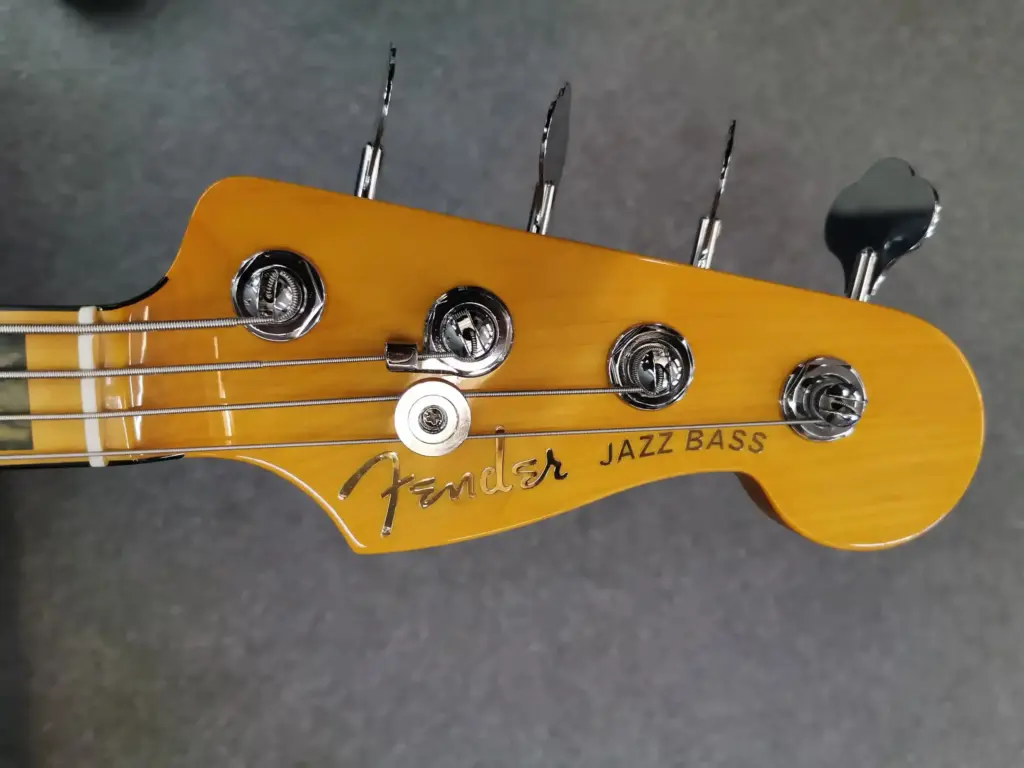
Fender used three different logos for guitars:
- Fender Spaghetti Logo.
The original, known as the “spaghetti logo,” features thin silver letters outlined in black and was used in the 1950s through the mid-1960s.
- Fender Transition Logo.
In late 1959, a new logo was introduced, co-designed by Robert Perine and Leo Fender. Known as the transition logo, it has bold gold letters with a thicker black outline. This logo was later called a transitional logo because it bridged the period between the thin spaghetti logo and the CBS era. The Jazz Bass, introduced in 1960, was the first model to sport this logo, which then appeared on all subsequent new models.
- Fender CBS Logo.
Following CBS‘s acquisition of Fender in 1967, the logo’s design stayed the same, but the color scheme inverted to black letters with a gold border.



Dating Fender by Pots
If the serial number is unreadable or missing, you can also estimate the age of a Fender by checking the potentiometer codes. The codes on the potentiometers reveal information about the manufacturer, as well as the year and week of production.
During the 1950s, Fender primarily used Stackpole brand potentiometers in their guitars. In 1963, they switched to the CTS brand. To cut costs, Fender purchased a large stock of CTS potentiometers in 1966, which were then installed in guitars until 1971. As a result, guitars made up to 1971 may contain potentiometers that carry the 1966 date code.
Dating Fender by Pickups
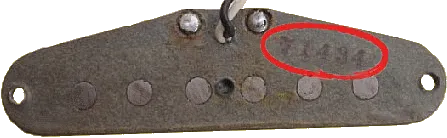
Another way to figure out when a Fender was made is to check the pickups. The date code on pickup consists of 3, 4, 5, or 6 numerals, without any letters.
The first 1 or 2 digits identify the Fender employee who wound the coil. The following numbers indicate the week and year of manufacture.
This method can be used for Fender Stratocaster, Telecaster, and Precision Bass pickups from the late 1960s to the early 1980s.
Since pickups were typically made before the guitar, you should add about six months to the date of the pickup to get the guitar’s construction date.
Another method to check the age of a Fender pickup is to measure its ohmic resistance (impedance). The impedance values provide an average based on measurements from pickups of that year.
This data, courtesy of Seymour Duncan, comes from extensive analysis and remanufacturing of numerous pickups.
Fender Pickup Date Codes
| OHM | Year | Wire OD | Insulation | Turns | Winding | Magn. Pole | Winding Method |
|---|---|---|---|---|---|---|---|
| 6.37k | 1963 | 0.0028″ | Formvar | 8319 | TL/TG | South | Hand |
| 6.33k | 1960 | 0.0028″ | Formvar | 8293 | TL/TG | South | Hand |
| 6.25k | 1964 | 0.0027″ | Formvar/Enamel | 7980 | TL/TG | South | Hand |
| 6.22k | 1962 | 0.0028″ | Formvar | 8220 | TL/TG | South | Hand |
| 6.20k | 1958 | 0.0028″ | Formvar | 8350 | TL/TG | North | Hand |
| 6.19k | 1961 | 0.0029″ | Formvar | 8119 | TL/TG | South | Hand |
| 6.02k | 1957 | 0.0029″ | Formvar | 8105 | TL/TG | North | Hand |
| 5.98k | 1956 | 0.0029″ | Formvar | 8012 | TL/GL | North | Hand |
| 5.95k | 1959 | 0.0030″ | Formvar | 7925 | TL/GL | North | Hand |
| 5.89k | 1955 | 0.0029″ | Formvar | 7844 | TL/GL | North | Hand |
| 5.88k | 1967 | 0.0027″ | Plain Enamel | 7656 | TL/GL | South | Machine |
| 5.80k | 1965 | 0.0026″ | Plain Enamel | 7626 | TL/GL | South | Machine |
| 5.76k | 1954 | 0.0030″ | Formvar | 7956 | TL/GL | North | Hand |
| 5.76k | 1966 | 0.0026″ | Plain Enamel | 7630 | TL/GL | South | Machine |
Fender Amps Serial Number
Dating a vintage Fender amp made before 1994 can be difficult, but several clues can help narrow down the production date.
Fender amps made from 1990 onward usually have a date code on the QA sticker on the back of the chassis.
Where to Find Fender Amp Serial Number (CHASSIS)?
In older versions, the serial number is stamped on the right-hand side of the chassis. However, in newer models, the serial number is presented on a sticker.
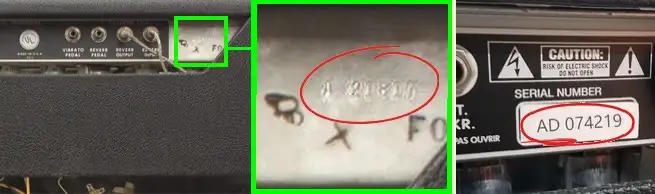
Fender Vintage Amps Serial Number 1951-1969
On the inside of the cabinets of Fender amplifiers that were built after 1950 and before 1970, a sticker is generally attached. This indicates the type of the tubes used and their location on the chassis. The sticker also has a two-letter date code, which may be stamped or handwritten.
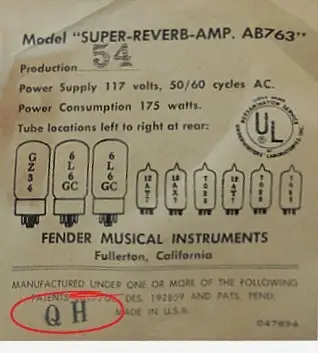
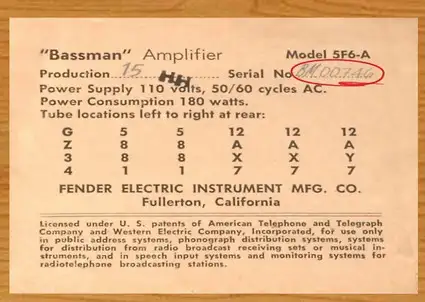
Fender amps Date code from 1951 to 1969
| Letter Code | Year | Month |
|---|---|---|
| A | 1951 | January |
| B | 1952 | February |
| C | 1953 | March |
| D | 1954 | April |
| E | 1955 | May |
| F | 1956 | June |
| G | 1957 | July |
| H | 1958 | August |
| I | 1959 | September |
| J | 1960 | October |
| K | 1961 | November |
| L | 1962 | December |
| M | 1963 | – |
| N | 1964 | – |
| O | 1965 | – |
| P | 1966 | – |
| Q | 1967 | – |
| R | 1968 | – |
| S | 1969 | – |
Fender Amps Serial Number Since 1990
All Fender amplifiers manufactured from 1990 until now, have a date code printed on the quality assurance (QA) sticker on the rear of the chassis. This black-silver sticker shows the signatures or initials of employees after the finished noise and electrical tests. The last line also has a stamped or handwritten 2-letter date code.
Handwritten codes can sometimes be difficult to read (see image). The first letter is the year and the second letter is the month.
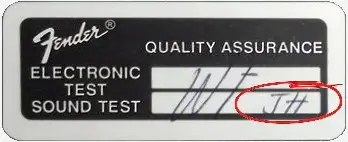
If the QA or tube chart sticker is missing or unreadable, check the right side of the rear chassis for a stamped chassis number. You can decipher the year of construction using the date decoder.
Fender amps Date code Since 1990
| Letter Code | Year | Month |
|---|---|---|
| A | 1990 | January |
| B | 1991 | February |
| C | 1992 | March |
| D | 1993 | April |
| E | 1994 | May |
| F | 1995 | June |
| G | 1996 | July |
| H | 1997 | August |
| I | 1998 | September |
| J | 1999 | October |
| K | – | November |
| L | – | December |
Fender Amps Production Dates by Models
| Model | Introduction | Discontinued |
|---|---|---|
| Bandmaster | 1953 | 1974 |
| Bandmaster Reverb | 1968 | 1980 |
| Bassman | 1952 | 1977 |
| Blues Deluxe | 1992 | 1999 |
| Blues Junior | 1990 | > |
| Bronco | 1967 | 1981 |
| Champ | 1948 | 1982 |
| Concert | 1960 | 1965 |
| Concert II | 1980 | 1987 |
| Deluxe | 1948 | 1966 |
| Deluxe Reverb | 1964 | 1979 |
| Deluxe Reverb II | 1982 | 1986 |
| Harvard | 1955 | 1963 |
| Hot Rod Deluxe | 1996 | > |
| Hot Rod DeVille | 1996 | > |
| Princeton | 1949 | 1979 |
| Princeton Reverb | 1964 | 1981 |
| Pro | 1946 | 1965 |
| Pro Junior | 1993 | > |
| Pro Reverb | 1965 | 1982 |
| Prosonic | 1996 | 2002 |
| Reverb Unit | 1961 | 1966 |
| Showman | 1960 | 1993 |
| Super | 1947 | 1963 |
| Super Reverb | 1963 | 1982 |
| Tremolux | 1955 | 1966 |
| Twin | 1948 | appeared in several variants until 2012 |
| Tube Reverb | 1976 | 1978 (reissue 1994-2016) |
| Vibrasonic | 1959 | 1964 |
| Vibrolux | 1964 | 1982 |
| Vibro Champ | 1964 | 1982 |
| Vibrosonic Reverb | 1972 | 1982 |
| Vibroverb | 1963 | appeared in several variants until 2008 |
| White Amp | 1954 | 1962 |
Dating Fender Amps by Label and Logo
Several other details can also help date a Fender amp:
- Before the CBS era, Blackface amps were labeled “Fender Electric Instrument.” Blackface amplifiers from 1964 and some from early 1965 did not have the Fender logo on the grill cloth.
- After 1973, Fender generally used the tailless logo. There was some overlap during the transition, so amps from 1973 and possibly 1974 may have either version.
- The logo on the grill cloth of the amplifier also indicates when it was produced. A logo with a tail is from before 1973. After 1973 the logo was tailless. With few exceptions. As long as there was a stock with tail logos, they were used randomly in 1973. Amplifiers from that year and perhaps also in 1974 can therefore have the new or old logo: tailless (after 1973), with tail (before 1973).

- There are some amplifiers from ‘68 and ‘69, including the Vibro Champ and Bassman, which also had a tailless logo. However, these logos are made of plastic and slightly smaller than the metals.
Dating Fender Amps by Components
If the stickers and chassis number are missing, the original components can also help estimate when the amp was made.
Transformer
With the help of the EIA (Electronics Industry Association) number on the transformer, the production date can be determined. The transformer date is not the same as the amp’s production date. A transformer may have been made months earlier and stored before it was installed.
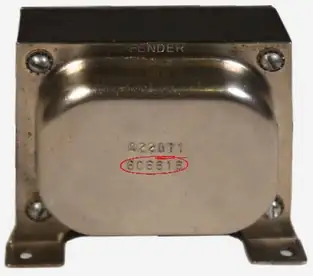
The EIA number on the transformer that Fender has used the most starts with 606, followed by 3 or 4 digits. 606 is the manufacturer (Woodward-Schumacher), but a transformer from another manufacturer may also have been used.
With 3 digits, the first digit is the last digit of the decade of the 20th century. The last 2 digits are the week of that year. At 4 digits, the first 2 digits are the year of the 20th century.
Example: 606 6849 is 1968 week 49. If the production date of the transformer is now known, add at least 6 months to the production date of the amplifier. From the example, the amplifier could have been built in 1969.
Speakers
What applies to the transformer also applies to speakers.
Fender used Jensen speakers until 1972. In that year the Jensen production was transferred to Rola (Rola was already a part of Jensen). When Rola started making speakers for Jensen in 1972, it also used Jensen‘s EIA code in the beginning (220). At the end of 1972, Rola changed the code to 285.
CTS Speakers.
Sometimes Fender used CTS speakers in the 1960s. Between the mid-1960s and early 1970s, the CTS 10-inch Alnico was regularly used in Super Reverbs.
Eminence Speakers.
Eminence (founded in 1966 by former CTS employee Bob Gault) made speakers especially for Fender according to those specifications. From the early eighties, these were standard in almost all tube amplifiers.
Utah Speakers.
Even though the Utah speakers from the 50s and 60s were of very good quality, Fender did not use them much during that period. It was not until the 1970s that these speakers became more widely used.
However, not all speaker manufacturers work with an EIA code. For example, Celestion has its date coding method that consists of 2 letters with 1 or 2 digits.
Examples:
GK12 is July 12, 1977;
23HA is August 23, 1956, or 1968.
Potentiometers
In the 1950s, Fender mainly used pots from the Stackpole brand (304). Halfway through 1963, the switch was made to the CTS brand (137).
In 1967, Fender bought a large stock of CTS potentiometers and continued using them for more than five years.
Fender amplifiers and guitars made in 1973 can therefore still have the 1967 potentiometer with EIA numbers from the stock that was purchased in 1967.
From 1974 a potentiometer with pressure-pull switch was added to some amplifiers.
Keep in mind that an old-looking Fender amp may not be completely original. Speakers, potentiometers, transformers, or even the cabinet covering may have been replaced.
Tolex is the flexible and waterproof vinyl material with which the cabinet or amplifier is covered. These changes do not necessarily affect the quality of the amp, as long as replacement components have the correct specifications.
You can also contact us directly or refer to additional sources like the official Fender website or thematic sites and forums.
FAQ
How Can I Find Out How Old My Fender Is?
To find out when your Fender guitar was made, try looking up its serial number. In most cases, it helps to determine the production date of the instrument. You can use the serial number decoder to find information about your fender. You’ll get all the details about your guitar: the country, production date, and even the factory.
What Does a Fender Serial Number Look Like?
Despite the name, a Fender serial number does not have to contain only digits. Many Fender serial numbers use a combination of letters and numbers.
What If My Fender Has No Serial Number?
If the serial number is missing or unreadable, you can still estimate the guitar’s age by checking the potentiometer and pickup date codes. The Fender logo can also help identify the production period.